
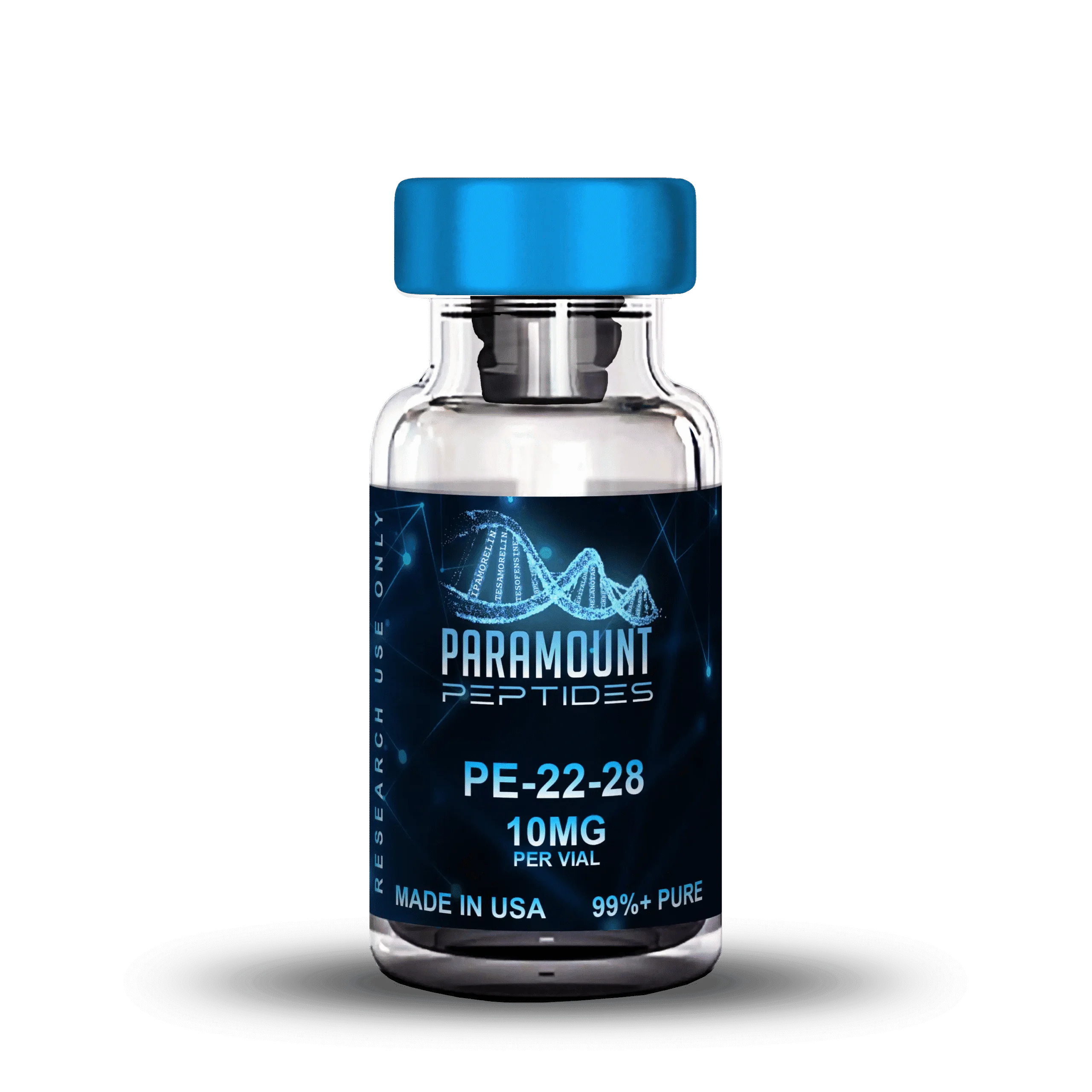
PE-22-28 (10mg)
Price range: £45.00 through £49.00
PE-22-28 (10mg)
High Quality – 99% Purity Guaranteed
We are continuously conducting HPLC test on all of our raw powders as well as finished products to ensure the quality of our products. You can have the product you bought from us tested at any HPLC licensed testing facility and if the results are negative, we will refund the following:
HPLC TEST FEE
$100
PLUS Total amount of the Order + Shipping Fee
PE-22-28 (10mg) in the UK has become a subject of growing interest within academic and scientific research environments. This synthetic peptide fragment, derived from endogenous protein sequences, attracts attention for its role in experimental studies focused on neurological signalling and peptide interaction pathways. Therefore, researchers across the UK continue to explore its characteristics in controlled laboratory settings.
Importantly, PE-22-28 (10mg) is not for human consumption and is strictly intended for research and educational purposes only. As a result, individuals searching for PE-22-28 (10mg) in the UK typically seek scientific data, experimental frameworks, and academic insights rather than consumer use.
Moreover, interest continues to expand across major UK regions, including London, Manchester, Birmingham, Leeds, Glasgow, and South East England. Consequently, PE-22-28 remains a relevant keyword in peptide research, neuroscience studies, and molecular biology discussions.
PE-22-28 is a short-chain peptide fragment derived from larger protein sequences involved in neural signalling pathways. Researchers study PE-22-28 because it may influence neurotransmitter activity, synaptic communication, and cellular signalling mechanisms in experimental models.
Additionally, PE-22-28 (10mg) in the UK is used in laboratory research to explore neurological pathways, peptide-receptor interactions, and signalling cascades. Scientists investigate how peptides like PE-22-28 affect cellular responses in controlled environments.
Furthermore, this peptide contributes to studies in neurobiology, molecular signalling, and experimental peptide science. Because these areas remain critical in modern research, PE-22-28 continues to attract attention among academic institutions.
Research activity surrounding PE-22-28 (10mg) in the UK is particularly strong in South East England, including London, Surrey, Kent, and Essex. These regions host leading universities and biotechnology laboratories focused on neuroscience and peptide research.
In addition, cities such as Manchester, Birmingham, Cambridge, and Oxford serve as major research hubs. Scientists in these locations explore peptide fragments like PE-22-28 to better understand neural signalling and receptor interactions.
Moreover, the availability of online research databases and scientific journals has increased visibility. As a result, search interest in PE-22-28 (10mg) continues to grow across UK academic and research communities.
PE-22-28 (10mg) in the UK supports several laboratory applications:
Additionally, researchers use PE-22-28 to explore synaptic activity and peptide modulation in controlled environments. Because neurological research remains a key area of scientific study, this peptide plays a role in experimental investigations.
Furthermore, its ability to model cellular responses enhances its value in academic research and laboratory experiments.
Peptide signalling plays a fundamental role in regulating biological processes, particularly in the nervous system. Therefore, PE-22-28 provides researchers with a model to study how peptides influence neural communication.
In addition, PE-22-28 interacts with receptors and signalling pathways that regulate neurotransmitter activity. Scientists analyse these interactions to gain deeper insights into molecular biology.
Moreover, peptide fragments like PE-22-28 help researchers understand how short amino acid sequences affect cellular behaviour and communication.
Safety is essential when handling research peptides. PE-22-28 (10mg) is not approved for human use in the UK and must only be used in controlled laboratory environments.
Researchers should follow strict protocols, including:
Furthermore, compliance with UK research regulations ensures ethical practices and reliable results. Because peptide research involves complex biological interactions, responsible handling is critical.
PE-22-28 attracts attention because of its potential role in neurological and molecular signalling research. Researchers value its ability to model peptide interactions and cellular communication processes.
Additionally, peptide fragments like PE-22-28 appear in scientific discussions, academic publications, and laboratory studies. As a result, they remain relevant in UK research communities.
Moreover, advancements in neuroscience and biotechnology continue to highlight the importance of peptide-based research, increasing interest in compounds like PE-22-28.
PE-22-28 differs from many peptides because it functions primarily as a peptide fragment involved in signalling pathways rather than a full-length hormone or growth factor.
While other peptides may focus on endocrine or regenerative processes, PE-22-28 targets neural signalling and receptor interactions. Therefore, researchers use it in neurobiology and molecular studies.
This distinction makes PE-22-28 particularly valuable for studying communication pathways in cells.
Academic institutions across the UK, including London, Oxford, Cambridge, and Manchester, actively study peptide fragments like PE-22-28. Laboratories use this compound to simulate neural signalling and cellular communication.
Additionally, researchers incorporate PE-22-28 into experimental models that explore neurotransmitter activity and receptor binding. These studies contribute to scientific publications and academic advancements.
Consequently, PE-22-28 remains an important subject in university research programs and biotechnology laboratories.
People searching for PE-22-28 (10mg) in the UK often ask:
Providing accurate answers ensures clarity and supports responsible scientific communication.
Responsible communication is essential when discussing research peptides. Therefore, all information about PE-22-28 should remain factual, educational, and research-focused.
Moreover, transparency helps prevent misuse or misunderstanding. Because PE-22-28 is not for human consumption, clear disclaimers are necessary.
The future of PE-22-28 research in the UK remains promising. Scientists continue to explore its role in neural signalling, peptide interactions, and molecular biology.
However, broader applications would require extensive clinical trials and regulatory approval. Until then, PE-22-28 remains strictly a research compound.
Consequently, ongoing studies will shape its future relevance in scientific research.
PE-22-28 (10mg) in the UK continues to gain attention among researchers, academics, and scientific institutions. Although it plays a valuable role in laboratory studies, it does not serve as a consumer product.
Therefore, individuals should treat PE-22-28 strictly as a research compound. Moreover, continued investigation will expand understanding in peptide signalling and molecular biology.
| Dose/ Qnty | 1 & more, 5 & more, 10 & more |
|---|


Reviews
There are no reviews yet.