

Description
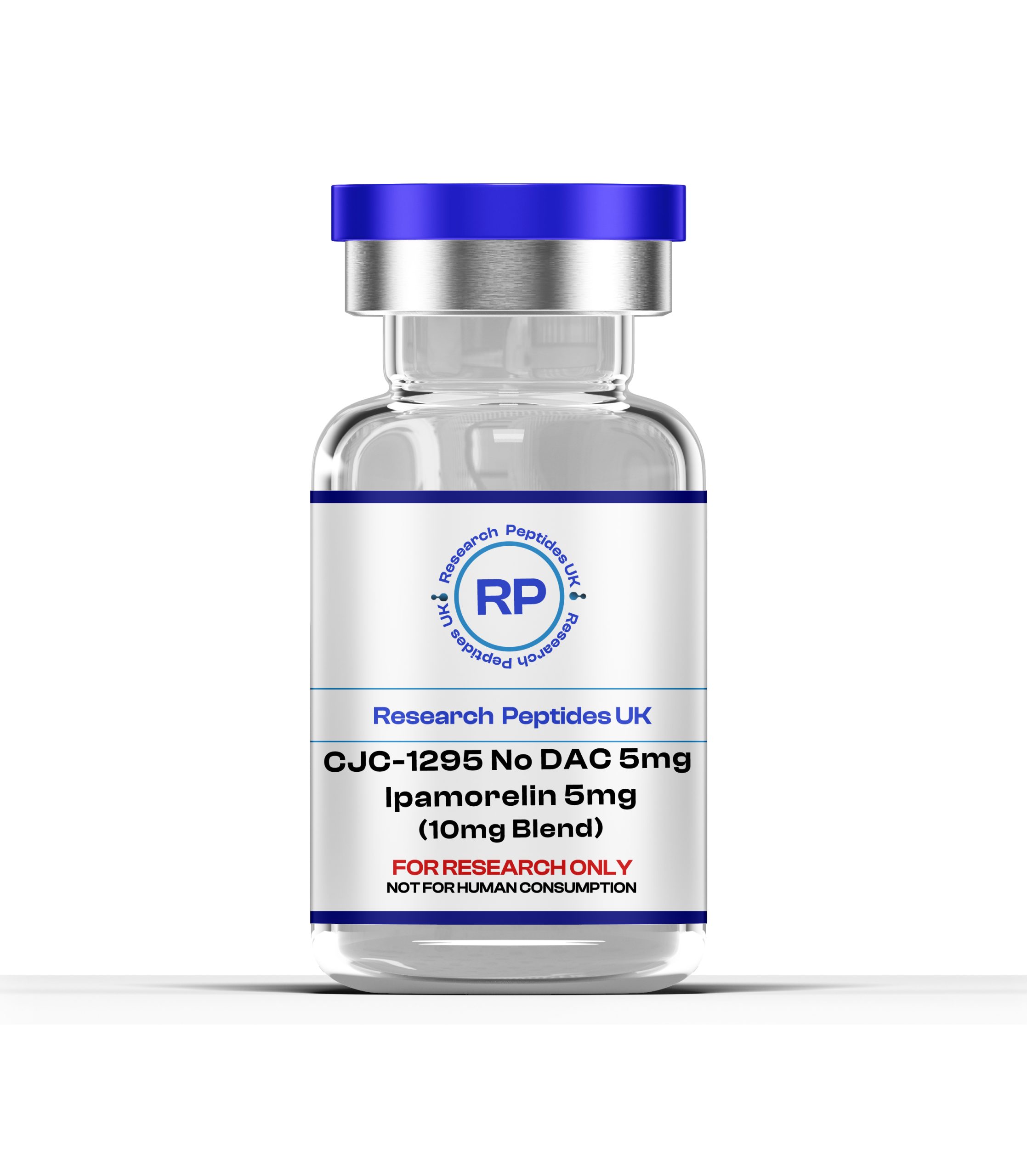
CJC-1295 No DAC 5mg + Ipamorelin 5mg (10mg Total Peptide Blend) – Research Grade
What Is the CJC-1295 No DAC and Ipamorelin Peptide Blend?
The CJC-1295 No DAC and Ipamorelin peptide blend is a research-grade combination of two well-documented synthetic peptides commonly studied in laboratory settings for their role in growth hormone–related signalling pathways.
CJC-1295 No DAC, also known as Modified GRF (1–29), is a synthetic analogue of growth hormone–releasing hormone (GHRH). Ipamorelin is a selective growth hormone secretagogue receptor (GHS-R) agonist. When examined together in research models, these peptides are frequently studied for their complementary receptor activity.
This product is supplied strictly for scientific research, laboratory analysis, and educational purposes only. It is not intended for human or animal use.
Chemical Composition and Molecular Information
Maintaining chemical accuracy is critical for peptide research. The molecular specifications below are consistent with established biochemical references.
CJC-1295 No DAC (Modified GRF 1–29)
- Peptide Name: CJC-1295 No DAC (Mod GRF 1–29)
- Molecular Formula: C₁₅₂H₂₅₂N₄₄O₄₂
- Molecular Weight: ~3367.9 g/mol
- Amino Acid Sequence:
Tyr-D-Ala-Asp-Ala-Ile-Phe-Thr-Gln-Ser-Tyr-Arg-Lys-Val-Leu-Ala-Gln-Leu-Ser-Ala-Arg-Lys-Leu-Leu-Gln-Asp-Ile-Met-Ser-Arg-NH₂ - Peptide Class: Synthetic GHRH analogue
Ipamorelin
- Peptide Name: Ipamorelin
- Molecular Formula: C₃₈H₄₉N₉O₅
- Molecular Weight: ~711.9 g/mol
- Amino Acid Sequence:
Aib-His-D-2-Nal-D-Phe-Lys-NH₂ - Peptide Class: Growth hormone secretagogue receptor agonist
The combined vial contains 5 mg of CJC-1295 No DAC and 5 mg of Ipamorelin, resulting in a total peptide content of 10 mg.
Mechanism of Action in Research Settings
In controlled research environments, CJC-1295 No DAC and Ipamorelin are studied for their distinct yet complementary mechanisms.
CJC-1295 No DAC interacts with GHRH receptors located in the anterior pituitary, triggering intracellular signalling pathways associated with endogenous growth hormone release in experimental models.
Ipamorelin acts on the ghrelin (GHS-R1a) receptor, which is also linked to growth hormone signalling. Unlike earlier secretagogues, Ipamorelin is often studied for its high receptor selectivity in laboratory research.
When combined, researchers explore how dual receptor stimulation may influence growth hormone pulse dynamics under controlled experimental conditions.
Research Applications of the Peptide Blend
This peptide blend is commonly referenced across several research areas:
Endocrine and Hormonal Signalling Research
The combination is studied to better understand growth hormone release mechanisms and pituitary signalling pathways.
Peptide Synergy and Receptor Interaction Studies
Researchers investigate how GHRH analogues and GHS-R agonists may work together at the receptor level in preclinical models.
Cellular Growth and Repair Pathway Research
Laboratory studies often examine downstream signalling related to cell growth, regeneration, and protein synthesis pathways.
Pharmacological and Receptor Mapping Studies
This blend is used to explore receptor binding, selectivity, and signal amplification in peptide research.
Handling and Storage Guidelines
- Supplied as a research-grade peptide blend
- Intended for qualified laboratory professionals only
- Store in a cool, dry environment
- Avoid repeated freeze–thaw cycles
- Follow standard laboratory safety and handling protocols
Regulatory and Research Status in the UK
CJC-1295 No DAC and Ipamorelin are not approved medicinal products in the United Kingdom. This peptide blend is distributed strictly as a research chemical, listed among peptides for sale UK for laboratory and scientific investigation only, and must not be used for therapeutic, diagnostic, or nutritional purposes.
Scientific References
- Teichman, S.L. et al. Prolonged stimulation of growth hormone secretion by CJC-1295. Journal of Clinical Endocrinology & Metabolism (2006). https://pubmed.ncbi.nlm.nih.gov/17018650/
- Thorner, M.O. et al. Growth hormone–releasing hormone and analogues. Endocrine Reviews (1995). https://pubmed.ncbi.nlm.nih.gov/8554013/
- Raun, K. et al. Ipamorelin, a selective growth hormone secretagogue. Journal of Endocrinology (1998). https://pubmed.ncbi.nlm.nih.gov/9648932/
- Smith, R.G. et al. Ghrelin receptor agonists and growth hormone release. Endocrine Reviews (2005). https://pubmed.ncbi.nlm.nih.gov/15769906/
- Kojima, M. et al. Ghrelin and growth hormone secretion. Nature (1999). https://www.nature.com/articles/386656a0
Research Use Disclaimer
FOR RESEARCH AND LABORATORY USE ONLY
This product is intend strictly for scientific research, laboratory testing, and educational purposes. It is not designed for use or consumption by humans or animals and must not be classified as a drug, food, cosmetic, or medicinal product.
By purchasing from coursecorrect.co.uk, the buyer accepts responsibility for correct handling, regulatory compliance, and ethical research use.
Product Description
CJC-1295 Without DAC | Buy CJC-1295 No DAC UK | Modified GRF (1-29) | Research Use Only
CJC-1295 Without DAC — also known as Modified GRF (1-29), Mod GRF (1-29), and tetrasubstituted GRF (1-29) — is a synthetic 29-amino acid analogue of human GHRH (1-29) incorporating four targeted amino acid substitutions that confer robust resistance to DPP-4 enzymatic cleavage, while preserving full GHRH receptor activity and extending effective half-life from the sub-10-minute window of native GRF (1-29) to approximately 30 minutes. Unlike its albumin-binding counterpart CJC-1295 With DAC, the no-DAC variant produces discrete, physiologically pulsatile GH release events — making it the preferred GHRH-class research tool for studying GH axis pulse dynamics, somatotroph receptor pharmacology, and GHRH-R-mediated signalling in controlled, short-duration experimental models. Buy CJC-1295 Without DAC in the UK from Peptides Lab UK with >99% HPLC-verified purity, batch-specific COA, and fast UK dispatch for laboratory and in vitro research use only.
Distributed by Peptides Lab UK in a high-purity lyophilised format, for laboratory research use only. This compound is handled in controlled settings for in vitro and pre-clinical studies, with no applications in human or veterinary medicine. Each batch undergoes rigorous quality analysis to ensure >99% purity (HPLC verified).
What Is CJC-1295 Without DAC (Modified GRF 1-29)?
Modified GRF (1-29), often abbreviated as Mod GRF (1-29) and originally known as tetrasubstituted GRF (1-29), is a 29-amino acid peptide analogue of growth hormone-releasing hormone. It is a modified version of the shortest fully functional fragment of GHRH — GRF (1-29), also known as Sermorelin — with the first 29 amino acids of GHRH having been shown to be equally potent as the full 44-amino acid GHRH structure. GRF (1-29) itself was found to suffer from rapid metabolic clearance, leading to the synthesis of analogues with substituted amino acids more resistant to enzymatic cleavage.
CJC-1295 Ipamorelin oral UK
CJC-1295 Without DAC, also known as Modified GRF (1-29), is a tetrasubstituted GHRH analogue that binds the GHRH receptor and activates cAMP/PKA-mediated GH synthesis, essentially mimicking the hypothalamic release signal but with enhanced stability against enzymatic degradation.
Modified GRF (1-29) is a synthetic modification of growth hormone releasing factor with D-Ala, Gln, Ala, and Leu substitutions at positions 2, 8, 15, and 27 respectively — substitutions that create a significantly more stable and longer-acting compound than either native GRF (1-29) or Sermorelin, while maintaining the same receptor interaction profile at the GHRH receptor.
An important terminological note for the research community: Modified GRF (1-29) is identical to the portion of CJC-1295 DAC that is not bound to the maleimidopropionamide (MPA) group, minus the terminal lysine. The presence of a free terminal lysine in a literal CJC-1295 peptide without DAC conjugation would have the opposite effect of DAC — it would drastically reduce the active life of the peptide to that of Sermorelin. What is correctly referred to as CJC-1295 without DAC in research and commercial contexts is therefore Modified GRF (1-29).
As a research compound, CJC-1295 Without DAC UK is the most widely used pulsatile GHRH-class secretagogue in pre-clinical GH axis research, and the reference GHRH component in the most extensively studied dual-pathway GH secretagogue combination — CJC-1295 No DAC + Ipamorelin — which is described in a separate Peptides Lab UK product listing.
How Does CJC-1295 Without DAC Work?
The Four Amino Acid Substitutions — Mechanism of Stability
Four targeted amino acid substitutions — D-Ala² (position 2), Gln⁸ (position 8), Ala¹⁵ (position 15), and Leu²⁷ (position 27) — give CJC-1295 Without DAC dramatically improved resistance to DPP-IV proteolytic cleavage compared to native GRF (1-29), which has a half-life of under 10 minutes. The D-alanine substitution at position 2 is specifically directed at blocking the primary DPP-4 cleavage site, while the remaining substitutions prevent additional enzymatic attack at susceptible positions and reduce oxidative degradation during storage and in vivo.
GHRH Receptor Binding and cAMP/PKA Signalling
Modified GRF (1-29) acts to increase growth hormone production and release by binding to the growth hormone-releasing hormone receptor on cells in the anterior pituitary — the same GHRHR target as native GHRH, Sermorelin, and Tesamorelin. Receptor engagement activates the Gs/adenylate cyclase pathway, increasing intracellular cAMP and engaging PKA-linked phosphorylation events that drive both GH gene transcription and pulsatile secretory granule exocytosis from somatotroph cells.
High GHRH-R Selectivity — No GHS-R1a Cross-Reactivity
Modified GRF (1-29) demonstrates high selectivity for GHRHR, with minimal cross-reactivity to other pituitary hormone receptors including the growth hormone secretagogue receptor (GHS-R1a) that mediates the effects of ghrelin and GHRPs such as Ipamorelin. This receptor selectivity makes it an ideal clean GHRH-R agonist for studies where the specific contribution of the GHRH pathway needs to be isolated from ghrelin/GHS-R1a biology.
Physiological Pulsatile GH Release Architecture
Unlike longer-acting formulations, the design of Modified GRF (1-29) emphasises short-duration action to preserve the pulsatile nature of GH release, which is critical for metabolic homeostasis. Its shorter duration of action more closely mimics the pulsatile nature of endogenous GHRH secretion, thereby supporting physiological episodic GH release patterns — in contrast to CJC-1295 with DAC, which produces sustained GH elevation with days-long GHRH-receptor occupancy.
Somatostatin Feedback Preservation
The no-DAC variant’s short half-life ensures GH is released in discrete bursts that respect somatostatin’s inhibitory feedback — an important distinction in research models where physiological GH axis dynamics and the somatostatin/GHRH interplay are the experimental focus. The pulsatile GH release profile is considered by many researchers to more closely mirror the natural hypothalamic-pituitary-somatotroph communication cycle than sustained GHRH-receptor stimulation.
What Does CJC-1295 Without DAC Do in Research?
In laboratory and pre-clinical settings, CJC-1295 Without DAC has been studied as the prototypical pulsatile GHRH-class secretagogue for GH axis biology. Research has examined its role in:
- GHRH receptor binding, Gs/adenylate cyclase activation, and cAMP/PKA signalling pathway studies
- Physiological pulsatile GH secretion modelling and somatotroph biology investigations
- GH and IGF-1 axis regulation and downstream anabolic signalling research
- DPP-4 resistance profiling and GHRH analogue structural pharmacology studies
- Somatotroph proliferation, GH mRNA transcription, and pituitary reserve research
- GH pulsatility architecture — pulse amplitude, frequency, trough levels, and inter-pulse intervals
- Somatostatin feedback dynamics and GHRH/somatostatin interplay modelling
- Metabolic pathway research — lipid oxidation, glucose homeostasis, and anabolic signalling
- GH axis ageing, somatopause, and GHRH pulse amplitude decline studies
- Dual-pathway synergy research when combined with GHS-R1a agonists such as Ipamorelin
- Comparative GHRH analogue pharmacology — Sermorelin, Tesamorelin, and CJC-1295 DAC
CJC-1295 Without DAC and Pituitary Somatotroph Biology
Research in GHRH knockout mice using the CJC-1295 backbone demonstrated that administration caused an increase in total pituitary RNA and GH mRNA, suggesting that proliferation of somatotroph cells had occurred — as confirmed by immunohistochemistry — establishing that the tetrasubstituted GHRH scaffold acts not only on acute GH release but also on transcriptional upregulation of GH gene expression and pituitary somatotroph reserve, findings directly relevant to the no-DAC variant’s receptor biology.
CJC-1295 Without DAC and DPP-4 Resistance Research
Research that led to the identification of the tetrasubstituted GRF backbone confirmed that all maleimido derivatives of hGRF(1-29) sharing the same four amino acid substitutions showed enhanced in vitro stability against DPP-IV and retained bioactivity in GH secretion assays in cultured rat anterior pituitary cells — establishing that the tetrasubstituted scaffold itself is responsible for DPP-4 resistance, independent of the DAC albumin-binding moiety.
CJC-1295 Without DAC and the Dual Receptor Research Model
CJC-1295 Without DAC engages the GHRH receptor pathway — activating cAMP/PKA-mediated GH gene transcription and vesicle exocytosis — while having no cross-reactivity with the GHS-R1a ghrelin receptor. When combined with Ipamorelin in dual-pathway research models, the two compounds engage both the cAMP pathway via GHRHR and the calcium signalling pathway via GHS-R1a simultaneously on the same somatotroph cell population — producing a synergistic GH pulsatility profile that neither compound achieves independently.
CJC-1295 Without DAC and Metabolic Research Models
Exploratory applications for Modified GRF (1-29) in pre-clinical research include models of growth hormone deficiency, HIV/AIDS-associated wasting and cachexia, idiopathic short stature, and metabolic syndrome — reflecting the breadth of GH axis research contexts in which physiological pulsatile GHRH stimulation is a relevant experimental tool.
What Do Studies Say About CJC-1295 Without DAC?
The published evidence base for CJC-1295 Without DAC draws on both the direct characterisation of the tetrasubstituted backbone and the extensive clinical and pre-clinical literature generated for CJC-1295 with DAC, which shares the same four amino acid substitutions and GHRH receptor pharmacology.
The Foundational Characterisation Study
The 2005 study by Jetté et al. that identified CJC-1295 as a long-lasting GRF analogue via albumin bioconjugation simultaneously confirmed the pharmacological profile of the tetrasubstituted GRF backbone — showing a 4-fold increase in GH area under the curve over a 2-hour period compared to native hGRF(1-29) in rats, with all three maleimido derivatives of the same tetrasubstituted scaffold demonstrating enhanced DPP-4 stability and full GHRH receptor bioactivity in anterior pituitary cell assays. This established the four amino acid substitutions as conferring substantially enhanced in vitro and in vivo potency independent of the DAC modification.
CJC-1295 Backbone Clinical Data — Relevant to the No-DAC Research Profile
Two randomised, placebo-controlled, double-blind, ascending-dose clinical trials of CJC-1295 DAC — which shares the same tetrasubstituted GHRH backbone as the no-DAC variant — produced dose-dependent increases in mean plasma GH concentrations of 2 to 10-fold for 6 days or more, and mean IGF-1 concentrations of 1.5 to 3-fold for 9–11 days. The studies confirmed the GHRH receptor pharmacological profile of the tetrasubstituted scaffold that underpins both variants, with the no-DAC form studied as the pulsatile delivery model and the DAC form providing the prolonged pharmacokinetic extension of that same receptor biology.
Pulsatile GH Architecture — Why the No-DAC Profile Matters
Research has confirmed that CJC-1295 Without DAC preserves the pulsatile nature of GH release — a feature considered critical for maintaining physiological GH axis dynamics, since the amplitude and frequency of GH pulses govern downstream effects on lean body mass, metabolic rate, and IGF-1 axis regulation. The no-DAC variant’s short ~30-minute effective half-life supports GH pulse patterns that more closely resemble endogenous GHRH-mediated secretion events than either CJC-1295 DAC or direct exogenous GH administration.
Sermorelin vs CJC-1295 Without DAC — The Research Upgrade
Compared to Sermorelin — the unmodified GRF (1-29) reference compound with a half-life of less than 10 minutes — CJC-1295 Without DAC’s four amino acid substitutions provide a substantially longer and more consistent research window while maintaining the same pulsatile GH release profile. The D-alanine substitution at position 2 specifically targets the primary DPP-4 cleavage site that limits Sermorelin’s in vivo stability, and additional substitutions further extend resistance to enzymatic degradation in biological matrices.
Key cited studies:
- Jetté L et al. (2005) — hGRF(1-29)-Albumin Bioconjugates Activate the GRF Receptor on the Anterior Pituitary in Rats: Identification of CJC-1295 as a Long-Lasting GRF Analog — Endocrinology 146(7):3052–3058. PubMed ID: 15817669. DOI: 10.1210/en.2004-1611
- Teichman SL et al. (2006) — Prolonged Stimulation of GH and IGF-1 Secretion by CJC-1295, a Long-Acting Analog of GHRH, in Healthy Adults — J Clin Endocrinol Metab 91(3):799–805. DOI: 10.1210/jc.2005-1536
- Ionescu M & Frohman LA (2006) — Pulsatile Secretion of GH Persists During Continuous Stimulation by CJC-1295, a Long-Acting GHRH Analog — J Clin Endocrinol Metab 91(12):4792–4797. PubMed ID: 17018654
- Alba M et al. (2006) — Once-Daily Administration of CJC-1295 Normalises Growth in the GHRH Knockout Mouse — Am J Physiol Endocrinol Metab 291(6):E1290–E1294. DOI: 10.1152/ajpendo.00201.2006
- Raun K et al. (1998) — Ipamorelin, the First Selective Growth Hormone Secretagogue — Eur J Endocrinol 139(5):552–561. PubMed ID: 9849822
CJC-1295 Without DAC vs Other GHRH-Class Research Peptides
| Feature | CJC-1295 Without DAC (Mod GRF 1-29) | CJC-1295 With DAC | Sermorelin (GRF 1-29) | Tesamorelin |
|---|---|---|---|---|
| Amino Acid Substitutions | 4 (D-Ala², Gln⁸, Ala¹⁵, Leu²⁷) | 4 + DAC reactive lysine at C-terminus | None (C-terminal amide only) | N-terminal trans-3-hexenoyl cap |
| DPP-4 Resistance | High (all 4 substitutions) | High (4 substitutions + albumin protection) | Low (rapid DPP-4 cleavage) | High (N-terminal cap) |
| Half-Life | ~30 minutes | 6–8 days | ~11–12 minutes | ~26–38 minutes |
| Albumin Binding | No | Yes (covalent, via DAC) | No | No |
| GH Release Pattern | Physiological pulsatile | Sustained with preserved pulsatility | Physiological pulsatile | Physiological pulsatile |
| GHRH-R Selectivity | High (no GHS-R1a cross-reactivity) | High | High | High |
| Somatostatin Feedback | Preserved | Partially modulated | Preserved | Preserved |
| Best Research Use | Pulsatile GH axis, dual-pathway stack with Ipamorelin | Sustained GH axis elevation studies | Ultra-short pulse reference, FSH/LH biology | VAT/lipid pathway and CV risk research |
| Dual-Pathway Stack | Yes (primary GHRH component with Ipamorelin) | Yes (sustained GHRH + acute GHRP) | Yes (shortest pulse GHRH reference) | No established stack model |
CJC-1295 Without DAC’s unique combination of four stabilising amino acid substitutions, full GHRH receptor selectivity, physiological pulsatile GH release architecture, somatostatin feedback preservation, and ~30-minute half-life makes it the most versatile and broadly applicable pulsatile GHRH-class secretagogue for GH axis research — and the defining GHRH component in the most widely studied dual-receptor GH secretagogue combination in pre-clinical literature.
Quality & Purity Assurance
Every batch of CJC-1295 Without DAC from Peptides Lab UK is:
- >99% pure — HPLC and mass spectrometry verified
- Supplied with a full Certificate of Analysis (COA) on request
- Lyophilised powder for maximum stability and long shelf life
- Manufactured under strict, controlled laboratory conditions
- Consistent batch-to-batch quality for reproducible research results
Buy CJC-1295 Without DAC UK — Product Specifications
| Property | Detail |
|---|---|
| Full Name | CJC-1295 Without DAC / Modified GRF (1-29) / Mod GRF (1-29) |
| Also Known As | Tetrasubstituted GRF (1-29), Mod GRF 1-29 |
| Sequence | H-Tyr-D-Ala-Asp-Ala-Ile-Phe-Thr-Gln-Ser-Tyr-Arg-Lys-Val-Leu-Ala-Gln-Leu-Ser-Ala-Arg-Lys-Leu-Leu-Gln-Asp-Ile-Leu-Ser-Arg-NH₂ |
| Amino Acids | 29 |
| Substituted Positions | 2 (D-Ala), 8 (Gln), 15 (Ala), 27 (Leu) |
| Molecular Weight | 3,368.7 g/mol |
| Molecular Formula | C₁₅₂H₂₅₂N₄₄O₄₂ |
| Effective Half-Life | ~30 minutes |
| Purity | >99% (HPLC verified) |
| Form | Lyophilised powder |
| Storage | Store dry at -20°C; protect from light |
| Solubility | Bacteriostatic water, sterile water, or suitable laboratory solvents |
CJC-1295 Without DAC Research Applications
CJC-1295 Without DAC (Modified GRF 1-29) peptide UK is supplied strictly for the following in vitro and pre-clinical research uses:
- GHRH receptor binding, Gs/adenylate cyclase activation, and cAMP/PKA signalling pathway studies
- Physiological pulsatile GH secretion modelling and somatotroph biology investigations
- GH and IGF-1 axis regulation and downstream anabolic pathway research
- DPP-4 resistance profiling and GHRH analogue structural pharmacology comparisons
- Somatotroph proliferation, GH mRNA transcription, and pituitary reserve studies
- GH pulsatility architecture — pulse amplitude, frequency, trough levels, and inter-pulse interval modelling
- Somatostatin feedback dynamics and hypothalamic-pituitary somatostatin/GHRH interplay research
- Metabolic pathway investigations — lipid oxidation, glucose homeostasis, and anabolic signalling
- GH axis ageing and somatopause biology — GHRH pulse amplitude decline modelling
- Dual-pathway synergy research as the GHRH component in combination with GHS-R1a agonists (Ipamorelin, GHRP-2, GHRP-6)
- Comparative pulsatile GHRH analogue SAR studies — reference compound for Sermorelin and Tesamorelin comparisons
Why Buy CJC-1295 Without DAC from Peptides Lab UK?
Peptides Lab UK is a trusted UK peptides supplier, providing research-grade compounds verified by independent HPLC testing. When you buy CJC-1295 Without DAC in the UK from us, you receive:
- >99% purity, HPLC and MS verified, third-party tested
- Full COA documentation per batch
- Fast same-day UK dispatch with tracked delivery
- Competitive pricing with bulk research discounts available
- Trusted by researchers across the UK and Europe
Reviews
There are no reviews yet.